Pessimistic vs Optimistic Lock: Concurrency Management Explained with Pizza (and Laravel Code)
Master Pessimistic and Optimistic Locking in Laravel without the headache. Real-world analogy with the last slice of pizza and practical code snippets to prevent production race conditions.
You try to keep the product team happy by shipping features faster than an ice cream melts in August, you deal with last-minute scope changes, and you're left with the nagging feeling of trying to catch the wind with a net.
Then the nightmare strikes: a race condition in production at 2:00 AM that casually shatters the integrity of your data.
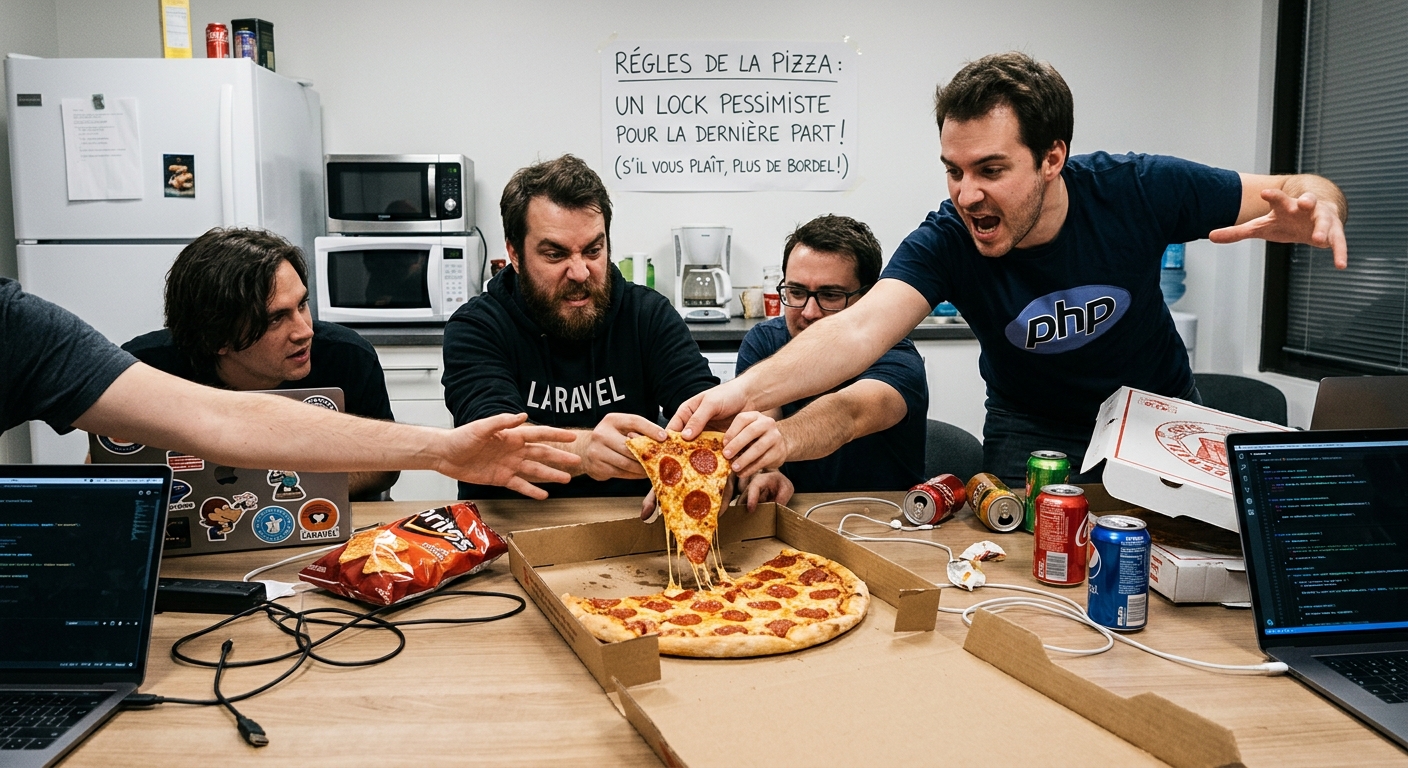
Managing database concurrency without breaking everything is a lot like negotiating the last slice of pizza at a project wrap-up party: if everyone dives in at the same time without rules, it's absolute chaos. To keep your database from turning into a crime scene, Laravel offers two major tools: Pessimistic Lock and Optimistic Lock.
Let's make this crystal clear using a dating app analogy.
1. Pessimistic Lock: A Woman's Profile on a Dating App
The metaphor
Imagine a woman on Tinder. She opens the app and instantly receives about 1,500 likes per second. If the platform allowed all requests to come in simultaneously without locking the row, the server would explode in two minutes flat.
The philosophy is pessimistic: "I assume everyone is going to rush to like here at once, so I'm locking everything right away."
In practice with Laravel
In Laravel, we handle this cleanly inside a transaction using dedicated methods:
- lockForUpdate() (Exclusive Lock): Nobody touches, reads, or modifies the row until your transaction finishes. The bouncer is on duty.
- sharedLock() (Shared Lock): Perfect for letting others read the data while strictly forbidding them from modifying it until you're done.
use App\Models\Profile;
use Illuminate\Support\Facades\DB;

DB::transaction(function () {
    // Exclusive write lock
    $profile = Profile::where('id', 1)->lockForUpdate()->first();
    $profile->increment('match_count');

    // Or safe read version without blocking other readers:
    // $profile = Profile::where('id', 1)->sharedLock()->first();
});
- When to use it? Banking systems, ultra-tight inventory management, or flash sales. Absolute security trumps pure performance.
2. Optimistic Lock: The Average Guy on Tinder (The Zen Approach)
The metaphor
Now let's look at an average guy's profile on the same app. Notifications are sparse, interactions are spaced out, and the chance of two people modifying the exact same profile at the exact same millisecond is close to zero.
The philosophy is optimistic: "We stay zen, it should go fine. If a conflict happens at checkout, we'll deal with it." No heavy locks dragging down database performance.
In practice with Laravel
Laravel doesn't have native optimistic locking magic out of the box, but a simple version column does the trick:
use App\Models\Profile;

$profile = Profile::find(1);
$currentVersion = $profile->version;

// ... the user updates their info peacefully ...

$updated = Profile::where('id', $profile->id)
    ->where('version', $currentVersion)
    ->update([
        'bio' => 'Too passionate PHP developer',
        'version' => $currentVersion + 1,
    ]);

if (!$updated) {
    throw new \Exception("Oops! Someone else modified this profile in the meantime.");
}
- When to use it? SaaS apps, user profiles, CMS platforms where reads vastly outnumber writes. It prevents needlessly locking the database.
Summary for Your Architecture
- Pessimistic (lockForUpdate / sharedLock): Maximum security, zero conflict risk, but watch out for slowdowns and deadlocks if order isn't respected.
- Optimistic (version column): Maximum performance and fluidity, application-level conflict handling.
As a freelancer, choosing the right locking strategy means you won't spend your weekends fixing production messes.
Need an audit of your Laravel architecture or SQL optimization? [Let's talk!]
Peter K
Senior Full-Stack Engineer • Freelance France